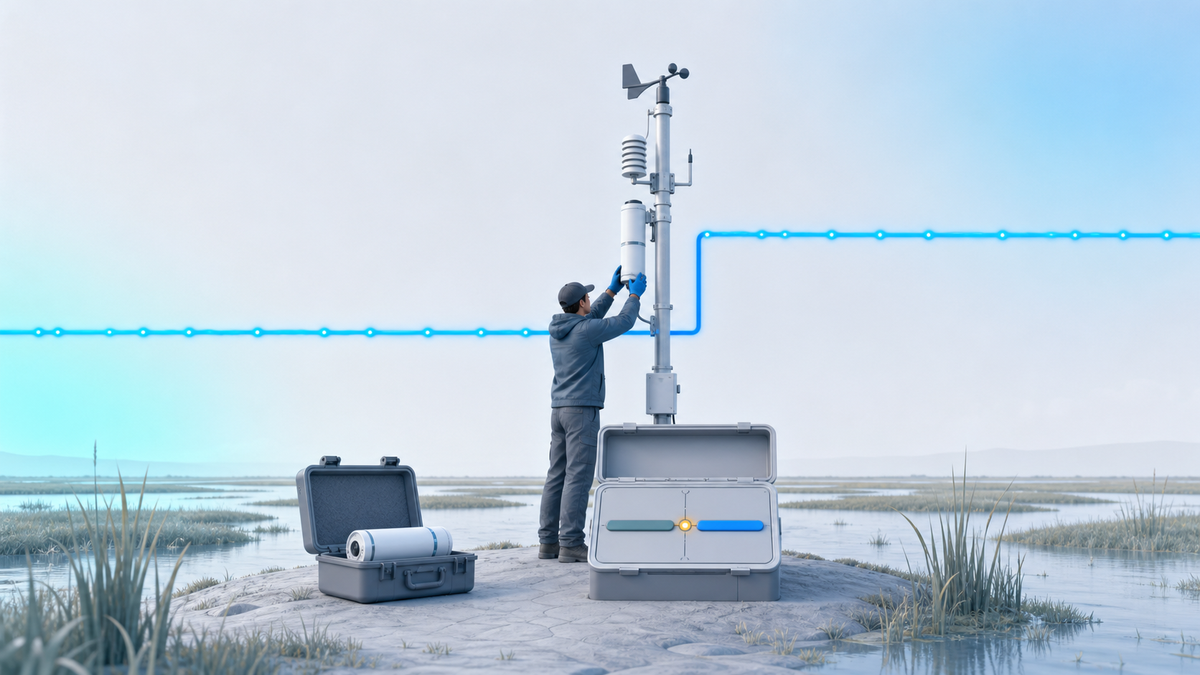
There's a step-change in your particulate matter series on March 14th. It's either the thing your monitoring program exists to catch, or it's the day a field tech swapped the sensor. Here's the uncomfortable question: can your data system tell you which? Not a colleague, not an email search, not the tech's memory or waterproof notebook notes; can the system know it, in a query?
For most teams the honest answer is no, and I'd argue that this is a provenance failure with a specific, fixable cause: we treat instrument maintenance activities as metadata when they're actually events.
Where deployment knowledge actually lives
Think about where "we swapped the sensor in March" is recorded in a typical program. A field notebook in a truck. A procurement email. A calibration vendor's PDF. A row in somebody's asset spreadsheet, updated when remembered. The knowledge exists, most field teams are diligent, but the info lives in places the data can't reconcile with, usually in formats a query can't join, and owned by people who eventually change jobs.
Meanwhile the data itself lives for years. That's the asymmetry that bites: the measurements outlive the memory of how they were collected. Two years later the step-change is still right there in the series, and the explanation has retired to Arizona.
It sure is nice buying a used car with a service book, because the odometer alone can't tell you whether 80,000 miles included regular maintenance or pedal-to-the-metal 'it hasn't blown up yet' ownership. The maintenance history is what makes the mileage interpretable. A long-running dataset is a used car. Its service book is the deployment record: which instrument, where, from when to when, and what changed. Most data stacks sell you the car and shrug off the book.
Deployments as events, not attributes
The fix is a data-model decision, and it's one of the quieter things we're proudest of in Datasparks. A deployment is an asset, at a sampling location, running a technology wth components. We enable users to treat deployments as first-class records with a time span: installed, and eventually removed. Swapping an instrument isn't an edit to a device row; it's an atomic operation that closes one deployment and opens the next, so the history has no seams. Moving an instrument to another site is the same shape. The database structurally refuses overlapping deployments for the same asset. An instrument cannot have been in two places at once, and the schema enforces the physics. Even corrections preserve the trail: a deleted deployment record keeps its original time window rather than being silently rewritten.
And the record isn't a passive registry off to the side. The ingestion pipeline consults it: when a reading arrives tagged with an asset, the pipeline resolves which sampling location that asset was deployed to at that timestamp and attributes the reading accordingly. Send data from a logger that was moved mid-month, and the readings land at the right site on both sides of the move because attribution flows through the deployment history, not through a static device-to-site mapping that you really hope Bill remembered to update in the spreadsheet.
So when the March 14th question comes, it's a lookup, not an investigation: open the deployment log timeline for that site, and the swap is sitting there with its date. I'll be precise about the current boundary, though, because I'd rather undersell this than oversell it: the platform keeps the record and routes your data through it, and the timeline gives you the answer when you ask. It does not yet draw the swap as an annotation on your chart or volunteer "this step-change coincides with a swap" unprompted. The record is the foundation; that kind of automatic cross-referencing is what the foundation makes possible, and I'd rather tell you what ships than what's in our future vision backlog.
Nobody else writes this book
Here's the part that genuinely surprised us when we scanned the field: no mainstream alternative natively links deployment changes to data attribution. The IoT platforms keep a device registry with current state, with a generic audit log behind it; useful for operations, but it tells you what the fleet looks like now, not which instrument produced a reading two years ago. The industrial historians can represent equipment events, but you hand-build that linkage for your tags. The cloud warehouses give you tables and wish you well. The deployment ledger becomes another bespoke thing your data engineer maintains. In fairness, each of those tools is solving its own job well; it's just that none of them considers "which physical instrument produced this measurement, and what happened to it since" to be the data layer's problem. In environmental work, it is the problem. This knowledge is the difference between a defensible time series and a plausible one.
This matters beyond audits, and one forward-looking reason belongs here: AI. A summary engine can only be as honest as the record it reads. An AI that can't see gaps misreads outages, and an AI with no deployment record will narrate your March swap as an environmental event, eloquently. Keeping the service book isn't nostalgia for paperwork. It's what makes every downstream consumer (human, regulator, or model) able to interpret the mileage.
The minimum viable service book
If you take nothing else from this post, take the schema, because it's small enough to adopt this week in any system. A spreadsheet with discipline qualifies. Five fields per deployment: which instrument (a stable identifier like a serial number, not "the blue one"), where it was, when it was installed, when it was removed, and who recorded the entry. Two rules: entries get written the day the hardware changes, and old entries never get edited. A correction is a new entry that says what it corrects. That's the whole book. Everything else (atomic swaps, overlap checks, pipeline attribution) is machinery for enforcing those two rules at scale, and it's worth automating precisely because human discipline is the part that breaks down first.
The principle, generalized past our product: provenance is written at the moment of the change, or it is never truly written. A deployment record reconstructed six months later from emails is an estimate wearing a record's clothes. Whatever system you run, ours, a historian, a spreadsheet with discipline, the test is the same: when hardware changes in the field, does that fact land somewhere with a timestamp, a time span, and a join path to the measurements? If yes, your March step-change is a two-minute lookup. If no, it's a two-week investigation that ends in "probably."
The one next step: take our evaluation rubric into your next platform conversation. This is dimension 11, the inspection item nobody thinks to check, and of the twelve it's one of the least arguable gaps between us and everything else. Ask any vendor, us included: show me, in the product, which instrument produced this reading, and what's happened to that instrument since. Then watch whether they open a screen or an email client.