The most defensible-sounding advice a sensor monitoring team ever gets is "put it all in a lakehouse." Snowflake and Databricks are genuinely extraordinary platforms and recommending them is the data-strategy equivalent of recommending a Fortune 500 auditor: nobody questions it. The problem isn't that the advice is wrong about the platforms. It's that it's wrong about you.
A sensor network is not a big-data problem. It's a complicated-data problem that happens to be medium-sized, and that distinction decides almost everything about what you should run and what it should cost.
What you'd be buying, credited properly
Let's establish what these platforms actually are, because the contrast means nothing otherwise. Snowflake and Databricks process effectively unlimited data with world-class reliability, governance, and ecosystem depth. Their AI investments, Cortex on one side, Genie and Mosaic on the other, are ahead of anything we ship, and I'll say that again later because it deserves more than a footnote. If you have petabytes, a data engineering team, and workloads across the whole business, they are the grown-up answer.
Every load-bearing word in that sentence, though, is an assumption: petabytes, a data team, whole-business workloads. An environmental or industrial program typically has none of the three. What it has is a few dozen instruments producing gigabytes, disagreeing about names, clocks, and quality, and scientists, not data engineers, on staff. Renting a container ship is impressive infrastructure. For a daily river crossing, it's also the slowest and most expensive option available.
Mismatch one: there's no domain in the lakehouse
A lakehouse arrives domain-empty by design, it's a substrate. The ship doesn't know what's in the hold; someone still has to write the manifest. Nothing in it knows what a monitoring well, a sampling interval, or an exceedance is. So step one of "put it in the lakehouse" is hiring someone to build the environmental layer: the schemas, the harmonization logic, the quality framework, the delivery surfaces. That person is a data engineer at roughly $200k a year fully loaded — in our cost model, that single salary line is roughly a hundred times what a mid-size sensor network meters on our entire platform in a year. And the layer they build is bespoke, which means it's also yours to maintain, document, and eventually explain to their successor.
Datasparks ships that layer as the product: assets, sites, instruments, and metrics as first-class entities; harmonization that preserves gaps by default; quality rulesets with recorded provenance; data products as governed deliverables. The comparison isn't "our engine vs their engine." It's "a domain platform with a designed data lake vs a very good empty warehouse plus a hiring req."
Mismatch two: the economics invert below 100 GB
Here's the part that surprised even us when we went looking for who had actually measured this. For the job sizes a sensor network actually produces, the lakehouse's distributed architecture isn't just unnecessary, it's a cost multiplier. You're paying for the crew and the berth when the crossing needed a rowboat. Below roughly 100 GB per job, a single-node vectorized engine like DuckDB (one machine, processing columns in bulk instead of rows one at a time) beats a rented Spark cluster by a wide margin on both speed and cost.
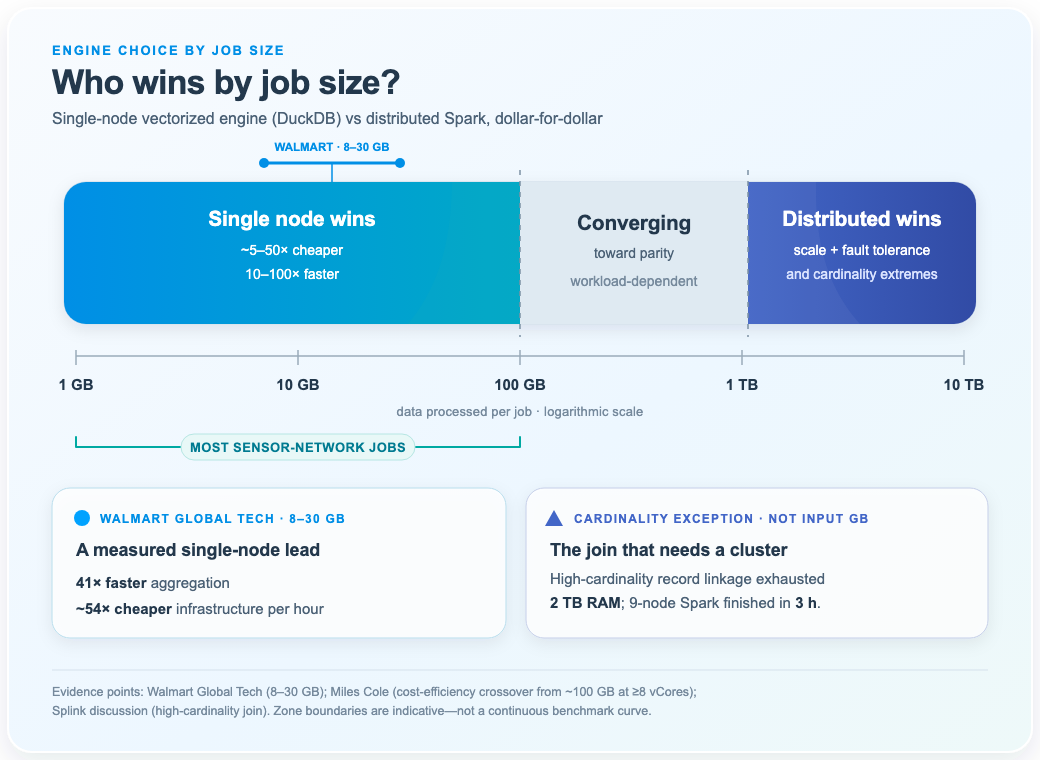
The numbers behind that chart aren't ours, which is rather the point. Walmart Global Tech benchmarked their own 8–30 GB workloads and measured DuckDB at 41× faster on aggregations and 13–16× on joins while the infrastructure ran about 54× cheaper per hour ($1.02 for a single VM against $55.64 for an 11-node cluster). The mechanism is structural, not a tuning issue: a classic cluster takes five to twelve minutes to spin up, which short jobs can never amortize; the platform bills its own compute units on top of the underlying VMs; and the JVM-and-shuffle machinery that makes distribution possible is pure overhead when one machine's memory would have sufficed.
And the boundary, stated with the same confidence: this inverts at scale. Miles Cole's benchmarking found Spark winning on cost-efficiency at 100 GB per job — the largest scale he tested — on machines of eight-plus vCores; our reading of the broader evidence is that the band from 100 GB to a terabyte converges toward parity, and above a terabyte, Spark wins outright. Cardinality can flip it even earlier: in one documented record-linkage thread, a join exploding into 3.3 billion candidate pairs ran a 500,000-record deduplication out of memory on a 2 TB single-node machine — while the same practitioner's 9-node Spark cluster chewed through an even larger 11-million-record run in three hours. Single nodes also concede fault tolerance on long jobs and concurrency at high user counts. If your jobs live above the crossover, use Spark. Ours, and almost certainly yours, live well below it: this is the "variety over volume" reality of sensor data. The hard part was never the gigabytes.
That engine choice is what we run, not just what we recommend: DuckDB does the heavy lifting in our ingestion pipeline and stores data in a partitioned datalake on hardware we own, and a second DuckDB compiled to WebAssembly runs inside your browser, so after the first sync your exploratory queries don't cross the network at all. No cluster spin-up appears on your bill because no cluster exists. Our meter is public and flat: $0.28 per compute-hour, with a free allowance and no base fee.
Mismatch three: their AI is powerful and domain-blind
Now the AI comparison, with the concession up front: on raw capability and maturity, Cortex and Genie lead us, clearly. If the contest is "most powerful assistant," they win it today. But a world-class navigator who has never sailed this river still doesn't know where the sandbars are.
But watch what happens when generic AI meets sensor data. Snowflake's own ML preprocessing documentation explains what its anomaly detection does when a time step is missing a value: the model fills it automatically — zero if the value aggregates as a sum, linear interpolation from the neighboring readings otherwise before training runs. Read that twice: the platform's answer to the single most meaningful feature of environmental data, the gap where an instrument was offline, is to quietly estimate a value and slide it into the sequence. There is no way to tell the model "this isn't a reading, this is an outage." The outage that is the anomaly gets interpolated toward invisibility as a built-in courtesy of the tool that's supposed to find it.
That's not a bug; it's what domain-blindness looks like from the inside. A generic assistant doesn't know a gap from a zero, a calibration artifact from an event, or a quality flag from a column of strings. Our AI is younger and narrower, today it generates insight reports and summaries, not conversations, but it reads your data through the platform's domain model: the quality scores, the resolved rules that flagged each value, what kind of instrument measured it. The argument is architectural, and I hold it with conviction: a domain-correct summary from a modest model beats a confident misreading from a powerful one, because an AI that doesn't know what a gap is will eventually tell a client something your data never said.
The honest scorecard
Choose Snowflake or Databricks when: your jobs regularly exceed the crossover, you employ (or will genuinely hire) data engineering, your workloads span the wider business, or you need today's most capable AI tooling and can supply the domain care yourself. Those are real cases and we'd rather lose them honestly than win them and disappoint you.
Choose the domain platform when the actual job is: a scientist-run program, sub-petabyte-scale ingestion, quality control you can stand behind, and sharing curated data with people who will never log into a warehouse console. That's the middle of the map this series' opener laid out, and it's where most environmental programs actually live.
One next step, whichever way you lean: don't take either side's word for it — take the 12-point rubric into the evaluation and make every vendor score against it. Dimension 7 is the one we concede. Watch which ones they concede because that's the real test of any vendor's pitch, ours included: not what they claim, but what they're willing to give up.